Atopic dermatitis: Why does the skin remain chronically dry and itchy?
Keywords: Atopic dermatitis, eczema, chronic dermatitis, pruritus, dry skin
Definition
Atopic dermatitis is a common chronic inflammatory skin disease characterized by dry skin, intense itching, and recurrent eczematous lesions. The condition typically begins in early childhood but may persist into adulthood. Atopic dermatitis belongs to the group of allergic diseases and is often associated with other allergic conditions such as asthma and allergic rhinoconjunctivitis, collectively referred to as the “atopic triad.” Although the disease is not contagious, it can significantly affect quality of life due to persistent itching, sleep disturbances, and an increased risk of secondary skin infections.
Epidemiology
Atopic dermatitis is one of the most prevalent chronic inflammatory skin diseases worldwide. It affects approximately 10–30% of children and 2–10% of adults, with most cases developing during early childhood. About 60% of patients experience symptom onset before the age of one year, and many cases appear before the age of five. Although some children experience improvement as they grow older, a considerable proportion continue to have symptoms into adulthood. In recent decades, the prevalence of the disease has increased significantly, particularly in industrialized countries, possibly due to environmental factors, lifestyle changes, and alterations in immune system responses.
Etiology and risk factors
The etiology of atopic dermatitis is multifactorial, involving interactions among genetic predisposition, skin barrier dysfunction, and environmental factors. One important genetic factor is mutation of the filaggrin gene, which encodes a protein essential for maintaining the structure and function of the skin barrier. When filaggrin is deficient or dysfunctional, the skin becomes more prone to water loss and more susceptible to irritation from allergens and environmental agents. Additionally, a family history of allergic diseases such as atopic dermatitis, asthma, or allergic rhinitis significantly increases the risk of developing the condition. Environmental triggers including house dust mites, pet dander, detergents, sweat, high temperatures, clothing made from synthetic fibers or wool, and certain food allergens such as eggs, milk, peanuts, and wheat may also provoke or worsen disease symptoms.
Pathophysiology
The pathophysiology of atopic dermatitis involves a combination of skin barrier dysfunction and abnormal immune responses. A reduction in lipids and ceramides in the stratum corneum increases transepidermal water loss and weakens the natural protective barrier of the skin, allowing allergens and microorganisms to penetrate more easily. Immunologically, the disease is associated with excessive activation of the Th2 immune response during the acute phase, leading to increased production of cytokines such as interleukin-4 and interleukin-5, which promote inflammation and itching. In the chronic phase, cytokines associated with the Th1 immune response, including interferon-gamma and interleukin-12, also contribute to the inflammatory process. Furthermore, colonization of the skin by Staphylococcus aureus is common in patients with atopic dermatitis and may exacerbate inflammation and increase the risk of skin infection.
Clinical manifestations
The most prominent symptom of atopic dermatitis is pruritus, which often worsens at night and may lead to sleep disturbances or impaired daily functioning. In addition to itching, patients may develop dry skin, erythema, swelling, small vesicles, oozing lesions, or crusting. Chronic scratching can eventually result in skin thickening and lichenification. The distribution of skin lesions varies with age. In infants, lesions commonly appear on the face, scalp, and extensor surfaces of the limbs. In older children, the flexural areas such as the elbows and knees are more frequently affected. In adults, lesions often involve the hands, neck, face, and other areas with skin folds or friction.
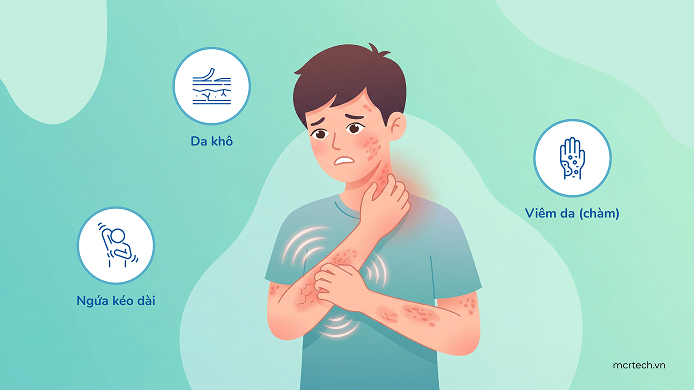
Illustration of the common clinical manifestations of atopic dermatitis.
Diagnosis
The diagnosis of atopic dermatitis is primarily based on clinical evaluation and patient history. Key diagnostic features include chronic pruritus, recurrent eczematous skin lesions, and a personal or family history of allergic diseases. In most cases, laboratory testing is not necessary for diagnosis. However, in certain cases where differentiation from other dermatological conditions is challenging, physicians may perform additional tests such as serum IgE measurement, allergen testing, or rarely, a skin biopsy to support the diagnosis.
Treatment and disease management
The management of atopic dermatitis focuses on controlling inflammation, relieving itching, and restoring the skin barrier. Daily skin care is essential and includes regular use of moisturizers to maintain skin hydration, taking short lukewarm baths, and avoiding irritants. During disease flare-ups, topical corticosteroids are commonly used as first-line therapy to reduce inflammation. Topical calcineurin inhibitors such as tacrolimus and pimecrolimus may also be used in certain cases. For patients with moderate to severe disease, other treatment options such as biologic therapy – particularly dupilumab – or phototherapy may be considered. In severe or treatment-resistant cases, systemic immunosuppressive agents such as cyclosporine, azathioprine, or methotrexate may be prescribed.

Principles of treatment and disease management for atopic dermatitis.
Complications
If not properly controlled, atopic dermatitis may lead to several complications. Common complications include bacterial skin infections, particularly those caused by Staphylococcus aureus, due to repeated scratching and skin barrier damage. Some patients may develop eczema herpeticum, a widespread infection caused by the herpes simplex virus affecting areas of eczematous skin. Chronic scratching may also lead to lichen simplex chronicus, resulting in thickened and rough skin. Additionally, the disease can significantly impact quality of life due to sleep disturbances, psychological stress, and reduced daily functioning.
Prognosis
Atopic dermatitis typically follows a chronic course characterized by periods of exacerbation and remission. In many children, symptoms gradually improve with age; however, some individuals continue to experience the condition into adulthood. Although there is currently no definitive cure, appropriate disease management through skin care, avoidance of triggers, and proper medication can effectively control symptoms and significantly improve patients’ quality of life.
References:
Cleveland Clinic. (2025, April 3). Atopic dermatitis. https://my.clevelandclinic.org/health/diseases/24299-atopic-dermatitis
Kolb, L., & Ferrer-Bruker, S. J. (2023, August 8). Atopic dermatitis. In StatPearls [Internet]. StatPearls Publishing. https://www.ncbi.nlm.nih.gov/books/NBK448071/