Skin cancer: It’s more than just sun exposure
Keywords: Skin cancer, melanoma, basal cell carcinoma, squamous cell carcinoma
What is skin cancer?
Skin cancer occurs when skin cells grow abnormally and uncontrollably. It usually begins in the outermost layer of the skin and can develop anywhere on the body, although it is most commonly found on areas that receive frequent sun exposure, such as the face, neck, ears, arms, and hands. Ultraviolet (UV) radiation from the sun is one of the leading causes of DNA damage in skin cells over time. However, skin cancer can also develop on areas that receive little or no sun exposure, so it should not be considered a condition that only affects people who spend a lot of time in the sun.
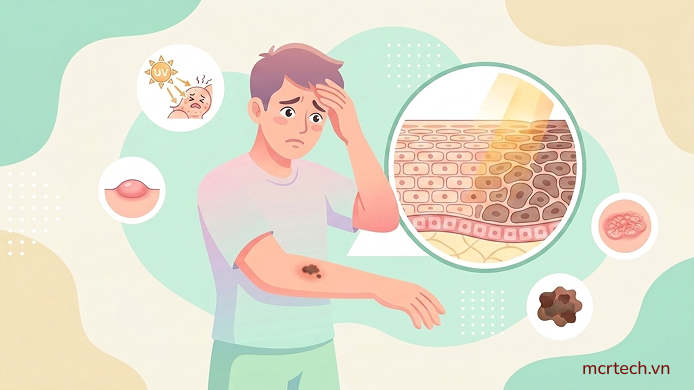
Illustration of the pathogenesis and clinical manifestations of skin cancer.
Common types of skin cancer
Skin cancer is classified into several types, with the most common being basal cell carcinoma, squamous cell carcinoma, and melanoma.
Basal cell carcinoma is the most common type and tends to grow slowly, with a low risk of spreading if detected early. Squamous cell carcinoma is also common and has a greater potential to invade nearby tissues or spread if left untreated. Melanoma is less common but is considered the most dangerous form because it can spread to other parts of the body if not diagnosed and treated promptly. In addition to these three major types, there are several rarer forms of skin cancer.
Signs and symptoms of skin cancer
The signs of skin cancer vary depending on the type. You may notice a new mole or an existing mole that changes in size, shape, or color. Some skin cancers appear as a small pink, red, or translucent bump, a scaly or thickened patch of skin, or a sore that does not heal and may repeatedly bleed or form a crust.
For melanoma, the ABCDE rule is commonly used to help identify suspicious moles:
- A (Asymmetry): One half of the mole does not match the other.
- B (Border): The edges are irregular, uneven, or poorly defined.
- C (Color): The mole contains multiple colors or uneven pigmentation.
- D (Diameter): The lesion is larger than approximately 6 mm.
- E (Evolving): The mole changes in size, shape, color, or develops symptoms such as itching, pain, or bleeding.
Not every unusual mole is skin cancer, but any skin lesion that continues to change or fails to heal should be evaluated by a dermatologist.
Who is at higher risk of skin cancer?
Skin cancer can affect anyone, but certain factors increase the risk. These include frequent exposure to sunlight or artificial UV radiation, a history of repeated sunburns, fair skin, light-colored hair or eyes, having many moles or atypical moles, a personal or family history of skin cancer, and a weakened immune system.
Age is also a risk factor because UV damage accumulates over time. However, melanoma can occur in younger people as well, particularly those with a history of excessive sun exposure or indoor tanning.
How is skin cancer diagnosed and treated?
If skin cancer is suspected, a healthcare provider will examine the skin lesion and may use a dermatoscope to evaluate it more closely. If the lesion appears suspicious, a skin biopsy is usually performed to confirm the diagnosis.
Treatment depends on the type of skin cancer, its size, location, and stage. Options may include surgical removal, Mohs surgery for selected cases, cryotherapy, curettage and electrodessication, radiation therapy, or systemic treatments such as immunotherapy, targeted therapy, or chemotherapy for advanced disease. When detected early, most cases of basal cell carcinoma and squamous cell carcinoma have an excellent prognosis.
Can skin cancer be prevented?
Although not all cases of skin cancer can be prevented, the risk can be significantly reduced by limiting exposure to UV radiation. Whenever possible, avoid direct sun exposure during peak sunlight hours, wear protective clothing, a wide-brimmed hat, and UV-blocking sunglasses, and apply a broad-spectrum sunscreen with an SPF of at least 30 before going outdoors. Sunscreen should be applied generously and reapplied regularly, especially after swimming or heavy sweating.
In addition, avoid using tanning beds, as they also emit harmful UV radiation that increases the risk of skin cancer. Performing monthly skin self-examinations and scheduling regular skin checks if you are at higher risk can also improve the chances of detecting skin cancer at an early stage.

Preventive measures to reduce the risk of skin cancer and ultraviolet (UV) exposure.
When should you see a doctor?
You should seek medical attention if you notice a mole or skin lesion that changes in size, color, or shape; a sore that does not heal after several weeks; an area of skin that repeatedly bleeds, crusts over, and returns; or a new growth that appears unusual. People with a previous history of skin cancer or multiple risk factors should also have regular skin examinations as recommended by their healthcare provider to detect any new suspicious lesions as early as possible.
References:
- Allan C. H., Ashfaq A. M., and Ofer R. (2026, March). Skin Cancer Information. https://www.skincancer.org/skin-cancer-information/
- Mayo Clinic. (2025, December 24). Skin cancer. https://www.mayoclinic.org/diseases-conditions/skin-cancer/symptoms-causes/syc-20377605