Dengue fever: A mosquito-borne threat and how to protect your health
Keywords: Dengue fever, Dengue virus, infectious disease, mosquito control
Definition
Dengue fever is an infectious disease caused by the dengue virus and transmitted to humans primarily through the bite of infected female mosquitoes, particularly Aedes aegypti. The disease is common in tropical and subtropical regions around the world, especially in urban and semi-urban areas. Most infections are asymptomatic or cause only mild illness; however, some cases may progress to severe dengue, which can result in hemorrhage, shock, or organ damage and may lead to death if not treated promptly.
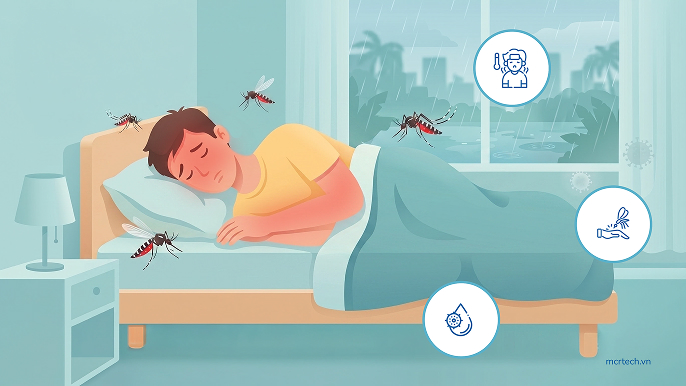
Illustration of the transmission and clinical manifestations of dengue fever.
Epidemiology
Dengue fever is currently one of the fastest-growing mosquito-borne diseases worldwide. The World Health Organization (WHO) estimates that approximately 100–400 million infections occur each year, with tens of millions of cases presenting clinical symptoms. The disease is now endemic in more than 100 countries, and about half of the world’s population is at risk of infection. The number of reported dengue cases has increased significantly in recent decades, with more than 14.6 million cases recorded in 2024. This rise is associated with several factors, including climate change, rapid urbanization, the expansion of mosquito vectors, and limited capacity of healthcare systems to effectively control outbreaks in many regions.
Etiology and risk factors
The causative agent of dengue fever is the dengue virus (DENV), which belongs to the family Flaviviridae and contains single-stranded RNA as its genetic material. The dengue virus consists of four distinct serotypes (DENV-1, DENV-2, DENV-3, and DENV-4), all of which can cause disease in humans. Infection with one serotype usually provides long-term immunity against that specific type but does not fully protect against the others. Therefore, a second dengue infection may increase the risk of developing severe disease. The mosquito Aedes aegypti is the primary vector responsible for transmitting the virus. These mosquitoes are most active during the daytime and typically breed in stagnant water sources close to human dwellings.
Pathophysiology
After an infected mosquito bites a human, the dengue virus enters the skin and infects immune cells such as macrophages and dendritic cells. The virus then replicates and spreads through the lymphatic system to other organs in the body. Viral infection may trigger a strong inflammatory response and disrupt vascular permeability. In severe cases, increased capillary permeability can lead to plasma leakage, reduced circulating blood volume, shock, and coagulation disorders. The course of the disease generally progresses through three phases: the febrile phase, the critical phase characterized by a risk of plasma leakage and shock, and the recovery phase when extravascular fluid is gradually reabsorbed.
Clinical manifestations
Most dengue infections are asymptomatic or present with mild symptoms. When symptoms occur, they usually begin 4–10 days after infection and last for about 2–7 days. Common symptoms include sudden high fever, severe headache, pain behind the eyes, muscle and joint pain, nausea, vomiting, and skin rash. In some cases, the disease may progress to severe dengue with warning signs such as severe abdominal pain, persistent vomiting, mucosal bleeding, rapid breathing, extreme fatigue, or the presence of blood in vomit or stool. These symptoms indicate a high risk of shock or severe bleeding and require immediate medical attention.
Diagnosis
The diagnosis of dengue fever is based on a combination of clinical manifestations, epidemiological factors, and laboratory tests. Common diagnostic methods include detection of viral RNA using PCR, identification of antigens or antibodies through immunological assays such as ELISA, and rapid diagnostic tests. In addition, hematological findings often reveal thrombocytopenia, leukopenia, and increased hematocrit during the critical phase. These laboratory results help confirm infection and assess disease severity.
Treatment
Currently, there is no specific antiviral treatment for dengue fever. Management is mainly supportive and includes adequate rest, fluid intake, and the use of antipyretic medications such as paracetamol to reduce fever and relieve pain. Non-steroidal anti-inflammatory drugs (NSAIDs) such as aspirin or ibuprofen should be avoided because they may increase the risk of bleeding. In cases of severe dengue, patients may require hospitalization for intravenous fluid therapy, hemodynamic monitoring, and management of complications such as shock or severe hemorrhage. Early diagnosis and proper medical care can significantly reduce the mortality rate associated with the disease.
Prevention
The most important strategy for preventing dengue fever is controlling mosquito vectors and avoiding mosquito bites. Preventive measures include eliminating standing water where mosquitoes breed, using bed nets or mosquito screens, wearing protective clothing, and applying mosquito repellents. In addition, strengthening epidemiological surveillance, increasing public awareness, and improving healthcare systems are crucial for controlling the disease. The WHO emphasizes that vector control remains the primary strategy for reducing the global transmission of dengue.
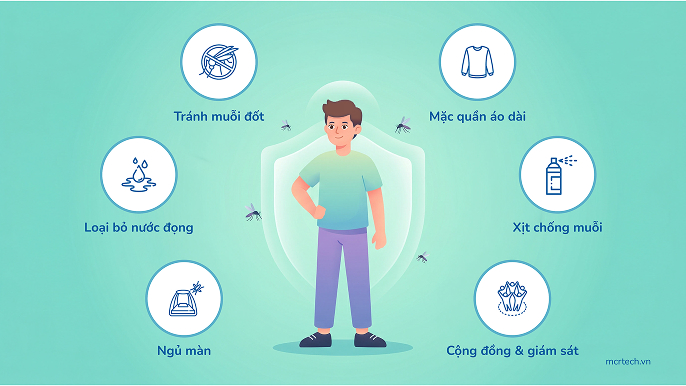
Preventive measures against dengue fever.
References:
- Schafer, T. J., Panda P. K., and Wolford R. W. (2024, March 6). Dengue fever. In StatPearls [Internet]. StatPearls Publishing. https://www.ncbi.nlm.nih.gov/books/NBK430732/
- World Health Organization. (2025, August 21). Dengue. https://www.who.int/news-room/fact-sheets/detail/dengue-and-severe-dengue