Dopamine addiction: When the brain is overloaded with rewards
Keywords: Dopamine, neurotransmitter, addiction, social media
In recent years, the phrase “dopamine addiction” has appeared more and more on social media to describe the condition where people find it hard to put down their phones, constantly scroll through TikTok, play games for hours, or rely on short-term stimulation to feel interested. However, dopamine is not an “addictive substance” in the way many people think. In fact, the real issue lies in the brain’s reward system being continuously overstimulated by the modern environment.
What is dopamine?
Dopamine is a neurotransmitter that plays a key role in the brain’s reward system. It is involved in motivation, learning, remembering behaviors, and driving people to seek out things that bring benefits or pleasure.
Contrary to the popular belief that dopamine is a “happiness hormone,” many studies show that dopamine is more closely related to the anticipation of a reward than to the actual feeling of pleasure when receiving that reward. In other words, dopamine makes people want to continue a behavior that is producing a feeling of excitement.
Under normal conditions, this mechanism helps humans survive. When we eat delicious food, engage in social interaction, or achieve something, dopamine increases to reinforce that behavior. However, in the modern environment, this system faces a level of stimulation far beyond what the brain evolved to handle.
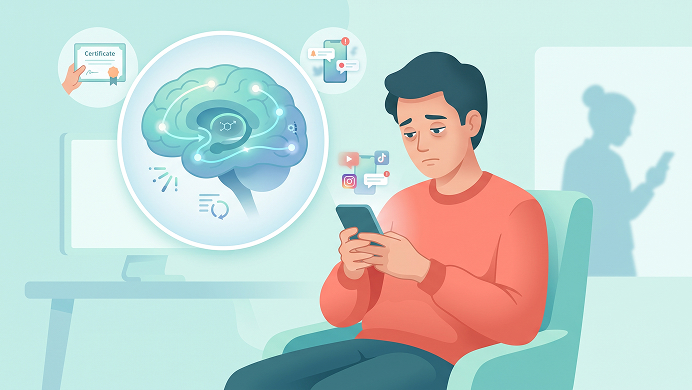
Illustration of dopamine’s role in regulating motivation, behavior, and reward processing.
Why is social media so addictive?
One reason platforms like TikTok, Instagram, or YouTube Shorts are so hard to stop using is that they operate on a “random reward” mechanism. Users never know whether the next video will be interesting or boring, and it is precisely this uncertainty that keeps the brain constantly anticipating the next reward.
Each time you scroll, the brain receives a small spike in dopamine. Even though this feeling is short-lived, it is enough to drive you to keep scrolling. This mechanism is similar to how slot machines work: rewards do not appear every time but randomly, making the brain even less likely to stop the behavior.
Notably, modern digital platforms are designed to maximize screen time. Notifications, likes, short videos, and personalized content all become sophisticated rewards that continuously act upon the brain’s reward system.
How does the brain change when overstimulated?
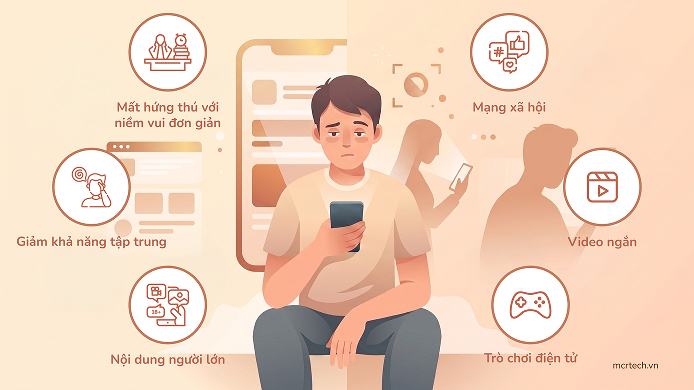
When the brain is continuously exposed to high-intensity stimuli like short videos, games, pornography, or social media, the reward system begins to adapt. To avoid being overwhelmed, the brain reduces its sensitivity to dopamine – a phenomenon often called tolerance or
desensitization. This means that over time, ordinary stimuli are no longer strong enough to produce the same level of interest as before. People begin to need more content, faster and more intense, to achieve the same level of stimulation.
The consequences include reduced attention span, increased difficulty with patience-requiring activities, and ordinary daily pleasures becoming boring. This is why many people find it hard to read books, study for long periods, or constantly lose focus while working. Their brains have become accustomed to the fast-paced stimulation of the digital environment.
Effects of excessive stimulation on the dopamine system and brain function.
Is "dopamine detox" really accurate?
On social media, the concept of a “dopamine detox” is often described as removing dopamine from the brain by staying off phones or avoiding stimulating activities. However, scientifically speaking, this is not entirely accurate. Dopamine is an essential neurotransmitter for life. It is involved in movement, learning, memory, motivation, and decision-making.
You cannot remove dopamine from your brain. What many people actually want to do is reduce excessive stimulation and help the reward system regain its normal sensitivity.
This explains why, after reducing social media use or limiting continuous stimulation, many people feel their focus improves and simple activities like reading or walking become more enjoyable again.
Why do things gradually become boring?
One of the most common consequences of overstimulation is reward desensitization, a reduced ability to derive pleasure from ordinary activities. When the brain becomes used to high-speed short videos, constant notifications, intensely stimulating content, or repeated dopamine spikes, activities that require deep focus like studying, working, or reading become more difficult.
Many people begin to feel unable to sit still, need constant background music or video, get bored quickly, or lose motivation for long-term tasks. This doesn’t mean something is wrong with their brain; rather, it reflects the reward system’s adaptation to an overly stimulating environment.
Is everyone addicted to dopamine?
The term “dopamine addiction” is often used loosely online, but in medical, addiction is a much more complex concept. True addiction typically involves loss of behavioral control, intense cravings, continued behavior despite known harm, and long-lasting neurological changes. Therefore, not everyone who uses their phone a lot has a “dopamine addiction.” However, many studies show that the modern digital environment is increasing the risk of developing dependent behaviors due to its continuous impact on the brain’s reward system.
The human brain never evolved for the modern environment
For most of evolutionary history, dopamine helped humans survive by driving them to seek food, build social relationships, explore the environment, and learn from experience.
Today, that same system is exposed to an almost infinite amount of stimulation: endless scrolling, short videos, constant notifications, and algorithms optimized to hold attention for as long as possible.
The human brain was never designed to process such a continuous flow of “rewards.” And perhaps the most concerning thing is not that technology is changing human behavior, but that it is gradually changing what the brain considers worth paying attention to.
References:
- The Cabin (n.d). Dopamine addiction: Symptoms, Causes, and How to overcome it. https://www.thecabinchiangmai.com/addiction-type/dopamine/
- Roy A. W and Chloe J. Jordan. (2021, December 2). Dopamine, behavior, and addiction. https://pmc.ncbi.nlm.nih.gov/articles/PMC8638539/